
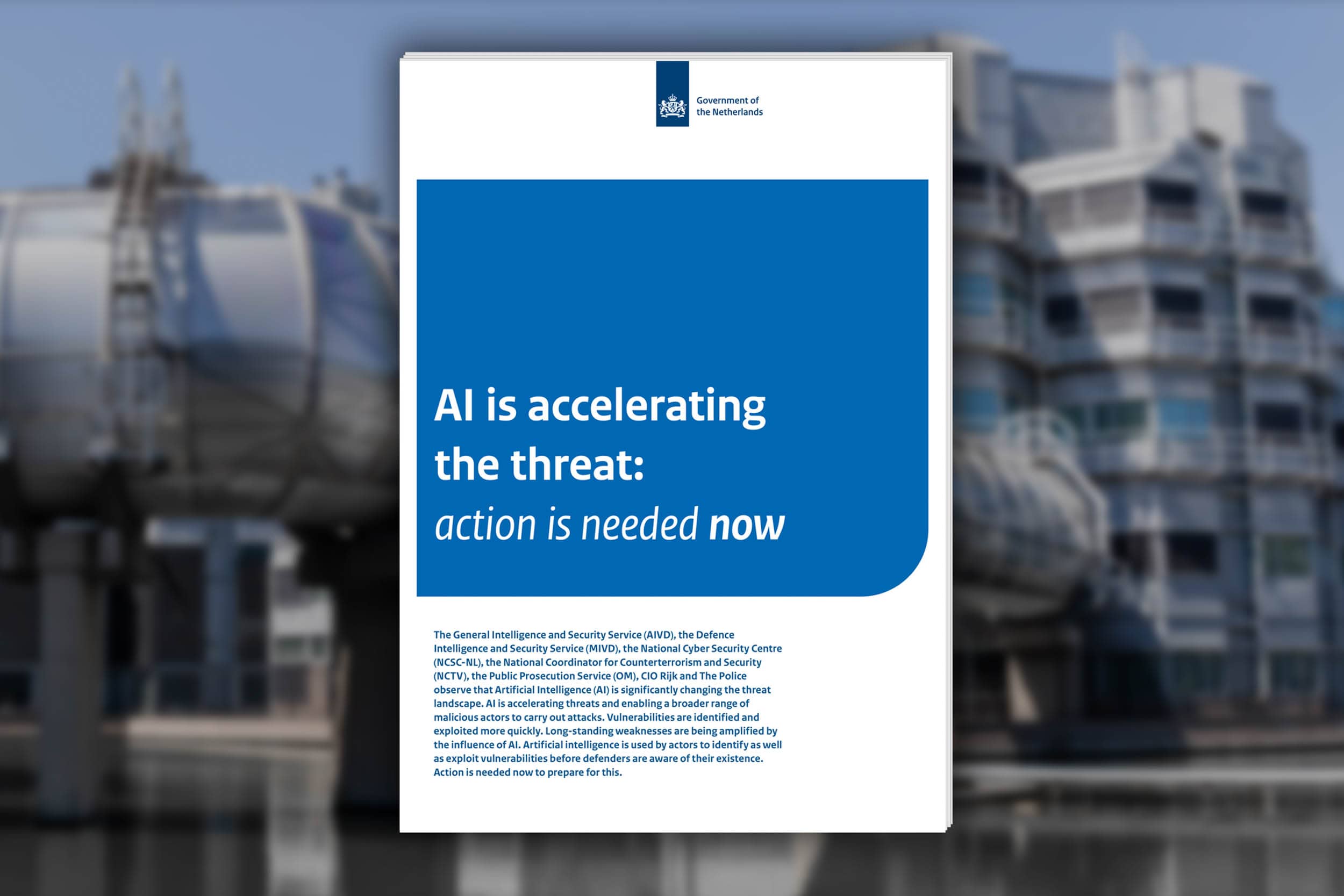
AI (Artificial Intelligence) accelerates and amplifies the threat of cyberattacks against our government and society. AI will increase the number, scale and complexity of cyberattacks. It is therefore vital to act now.
The National Coordinator for Counterterrorism and Security (NCTV), the National Cyber Security Centre (NCSC), the General Intelligence and Security Service (AIVD), the Defence Intelligence and Security Service (MIVD), the Public Prosecution Service (OM), CIO Rijk and the Police emphasise this message in a joint statement. These organisations urge senior leaders to take responsibility and prioritise cybersecurity.
We regularly see the consequences of inadequate defences against cyber incidents: prolonged outages of (critical) systems affecting large numbers of people, as well as the theft of large volumes of names, addresses and citizen service numbers, with all the attendant privacy-related and financial consequences.
Marc Kuipers, National Coordinator for Counterterrorism and Security: “Technology is developing rapidly and the capabilities of AI are increasing. We do not want to wait until we see the consequences of this on a large scale in the form of cyber incidents. That is why we are warning organisations now: prepare for this development.”
The statement urges leaders to make appropriate resources available, prioritise cybersecurity and give experts the scope they need to strengthen the Netherlands’ resilience. The statement also proposes three actions that leaders can take immediately to fulfil their responsibilities:
- Get the basics in order
- Ask yourself: Is our level of security still appropriate?
- Take AI signals seriously
These actions are further described in the statement.
Matthijs van Amelsfort, CEO National Cyber Security Centre: “AI is automating the kill chain, from identifying vulnerabilities to exploiting them. This technology can therefore accelerate and amplify existing cyber threats. That is why it is more important than ever to have basic security measures in place.”
Vulnerabilities are identified and exploited more quickly
AI lowers the barrier to entry for attackers and enables a broader range of malicious actors to carry out cyberattacks. AI is identifying and exploiting vulnerabilities ever more quickly. A new reality is emerging, one that public- and private-sector organisations have to adapt to.
Malicious actors primarily use AI to automate, accelerate or improve the efficiency of their attack techniques: cyberattacks can become more advanced and remain undetected for longer. Attackers do not need to use the most advanced frontier models. Attacks can already be carried out using existing and readily accessible AI models.
AI developments require new leadership
Digital security is no longer the domain of only CISOs and IT departments. The dependence on digital systems is too great, the interconnectedness too complex and the risks too extensive. Strengthening the Netherlands’ digital resilience is therefore a shared responsibility of public- and private-sector organisations.
The most important step that must now be taken is not primarily a technical one: it requires greater awareness and a different kind of leadership. Cybersecurity is not an operational detail but an organisation-wide challenge that requires strong governance at the senior level and a clear recognition of societal responsibility.